

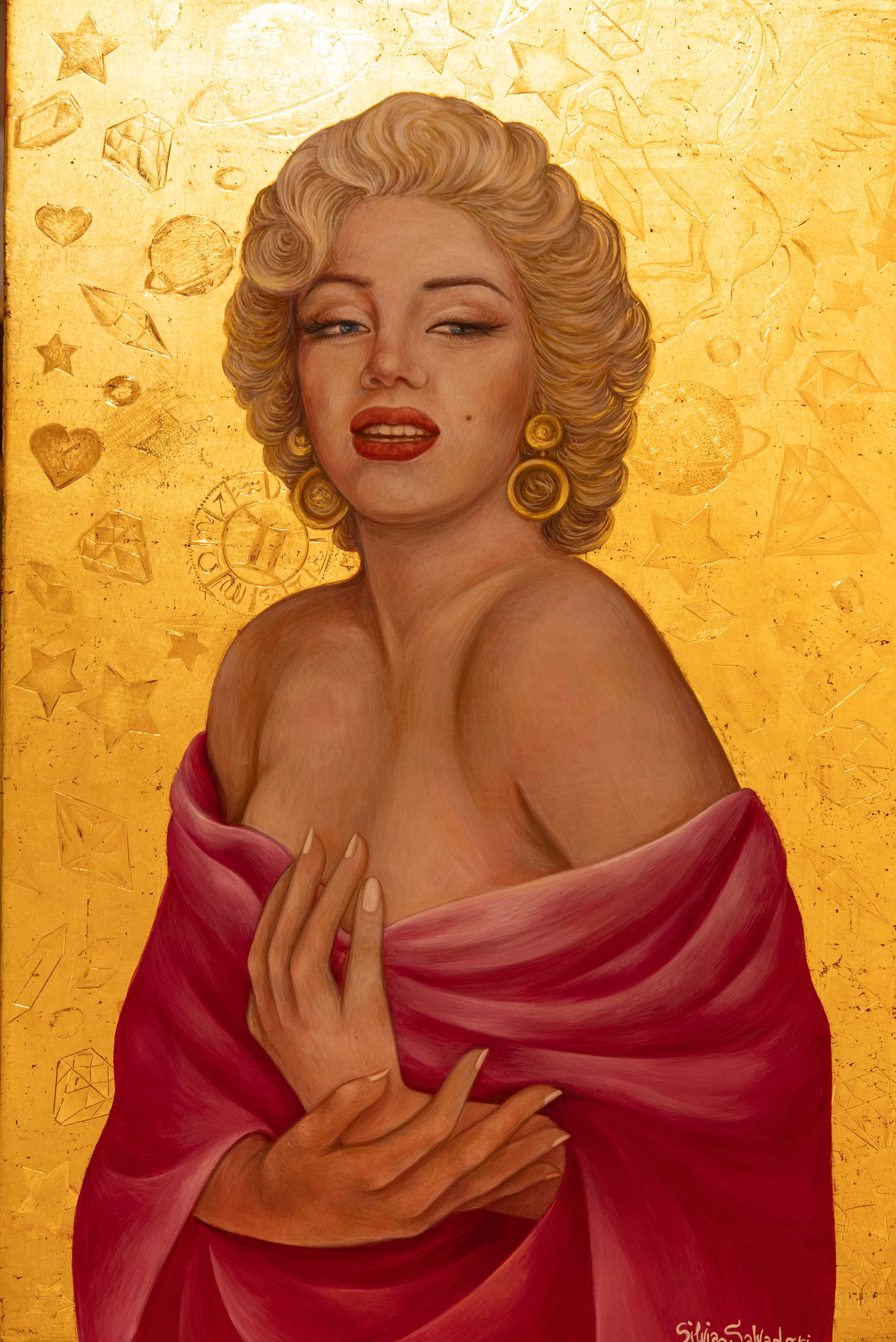
 Marilyn Monroe Tempera and Gold on wood. Panel Painting on gold
Silvia Salvadori / Copyright 2025
Tempera and pure gold 23 K
Dipinto su fondo oro zecchino 23 carati incisioni eseguite a bulino secondo le antiche tecniche pittoriche delle scuola senese del 1300
On
Portrait
Marilyn Monroe Tempera and Gold on wood. Panel Painting on gold
Silvia Salvadori / Copyright 2025
Tempera and pure gold 23 K
Dipinto su fondo oro zecchino 23 carati incisioni eseguite a bulino secondo le antiche tecniche pittoriche delle scuola senese del 1300
On
Portrait
Portrait
Portrait of Marilyn Monroe
Tempera on gold 23 carat.
Tempera e oro zecchino su tavola. Incisioni su oro zecchino eseguite a bulino con la tecnica originale della scuola senese del Primo Rinascimento toscano.
Oro zecchino, tecnica rinascimentale, Dipinto di Silvia Salvadori
40 x 60 cm
Marilyn Monroe Tempera and Gold on wood. Panel Painting on gold
Silvia Salvadori / Copyright 2025
Tempera and pure gold 23 K
Dipinto su fondo oro zecchino 23 carati incisioni eseguite a bulino secondo le antiche tecniche pittoriche delle scuola senese del 1300
On
Portrait
Marilyn Monroe Tempera and Gold on wood. Panel Painting on gold
Silvia Salvadori / Copyright 2025
Tempera and pure gold 23 K
Dipinto su fondo oro zecchino 23 carati incisioni eseguite a bulino secondo le antiche tecniche pittoriche delle scuola senese del 1300
On
Portrait

"The Heart of Women".
Il Cuore delle Donne.
Dipinto di Silvia Salvadori.
"Presta attenzione,
mia cara Sorella.
Un filo rosso lega i sensi al Cuore.
Il cuore si allena, il cuore si educa.
Il cuore apprende, il cuore si nutre.
Il cuore è un ripetitore che, a ritmo, espande ed attrae ciò con cui è nutrito.
Scegli di indugiare con lo sguardo sulla Bellezza.
Niente altro che Bellezza attraversi i tuoi occhi.
Nutri il cuore con la Potenza della Visione.
Scegli di ascoltare solo l'Armonia.
Niente altro che Armonia attraversi le tue orecchie.
Nutri il cuore con la Potenza del Suono.
Scegli di pronunciare solo parole di Gratitudine e Saggezza.
Niente altro che parole di Gratitudine e Saggezza
attraversino la tua bocca.
Nutri il cuore con la Potenza della Parola.
Presta attenzione, mia dolce Sorella.
Un filo rosso lega i sensi al Cuore.
Espandi e attrai ciò con cui lo alimenti.
Questa è la Potenza della Cuore."
(Poesia di Daniela Libanori)
61 x 38 cm
 Paintend by Silvia Salvadori
Tempera and gold
"Il cuore delle Donne"
Dipinto di Silvia Salvadori
- Copyright 2022 -
On
Portrait
Paintend by Silvia Salvadori
Tempera and gold
"Il cuore delle Donne"
Dipinto di Silvia Salvadori
- Copyright 2022 -
On
Portrait
Paintend by Silvia Salvadori
Tempera and gold
"Il cuore delle Donne"
Dipinto di Silvia Salvadori
- Copyright 2022 -
On
Portrait

Dipinto di Silvia Salvadori
"Una finestra sul Tempo" The work is a tribute to Arezzo and to the painting of Piero della Francesca. The element of the chessboard retains a great evocative and symbolic force. The chessboard in art represents the mathematics, philosophy, poetry and painting of the Renaissance where everything was constructed in a strictly geometric way. The lady painted in Renaissance clothes supports and embraces Arezzo immersed in a white space as if almost pushed by a massive explosion of pure energy. The Arezzo painted by Giotto appears to the viewers as a real heavenly Jerusalem "like a very precious gem, like a stone of crystalline jasper". Sizes: 80 x 100 cm 80 x 100 cm Tempera and gold on wood
Tecnica originale della scuola senese del XIV sec. Applicazione di pietre preziose su oro zecchino
On
Portrait
Tempera and gold on wood
Tecnica originale della scuola senese del XIV sec. Applicazione di pietre preziose su oro zecchino
On
Portrait


Portrait of Marilyn Monroe in Gold by Silvia Salvadori
Renaissance Pop Art series.
Limited Edition.
The painter Silvia Salvadori, once again comes out of her comfort zone, to portray the Icon par excellence, immortalized by the greatest contemporary artists, one above all Andy Warhol , who happens to be a previous portrait painted by the artist from Arezzo, also him torn between the public figure linked to excesses, not his own and the shy Andy Warhol who would have liked to be a prince charming but who died a virgin ...
and also his two worlds Silvia was able to make them converge in a single image. As with Andy Warhol, everything starts from a photograph that Silvia Salvadori manages to reproduce with techniques that only she is the master of, and perhaps this is also the secret of the faces painted by her brush, which although unquestionably resembling the original, seem to acquire a light new face ... Remember that one thing is the Marilyn Monroe moving on set, another the blonde girl trying to live a normal life out of the spotlight. Once the writer Truman Capote caught her looking in the mirror and when asked what she was doing, she replied "I look at her".
Incredibly, the actress could walk undisturbed in New York without anyone recognizing her, then suddenly she changed her attitude, step, look and then everyone stopped her to ask her for an autograph.
She used to admit with a smile: “I wanted to be Marilyn Monroe for a moment”.
Art Critic.
Alessio Musella
33x37,5 cm
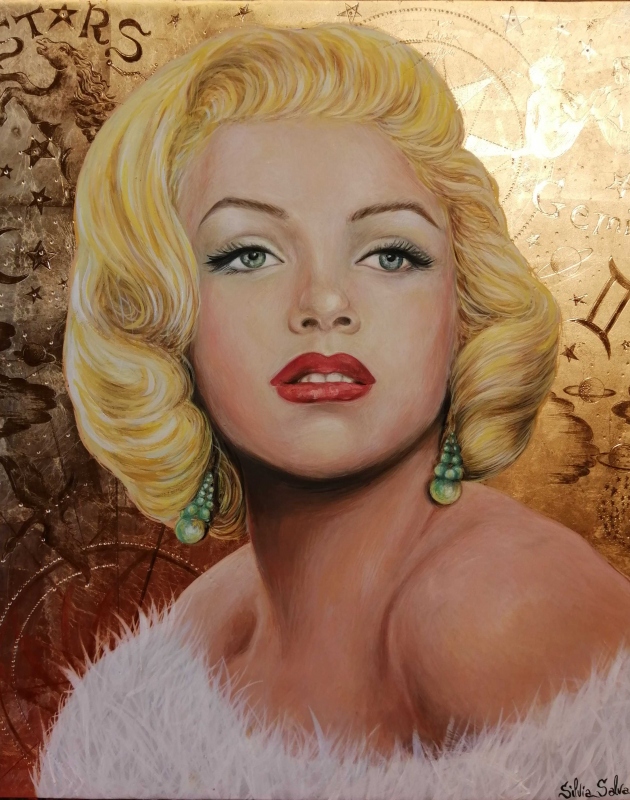 Tempera painting on a pure gold background entirely engraved with a burin and depicting the celestial vault with its zodiac sign of Gemini.
Silvia Salvadori
Egg tempera painting . Tempera and gold painting
Tempera and gold painting.
Ancient tecnique of painting.
Engravings on pure gold .
On
Portrait
Tempera painting on a pure gold background entirely engraved with a burin and depicting the celestial vault with its zodiac sign of Gemini.
Silvia Salvadori
Egg tempera painting . Tempera and gold painting
Tempera and gold painting.
Ancient tecnique of painting.
Engravings on pure gold .
On
Portrait

Ritratto di un Cagnolino
Cucciolo di Bassotto
Tempera su fondo oro zecchino
Decorazioni a pastiglia su oro e pietre preziose
 tempera and gold on wood
On
Portrait
tempera and gold on wood
On
Portrait
tempera and gold on wood
On
Portrait
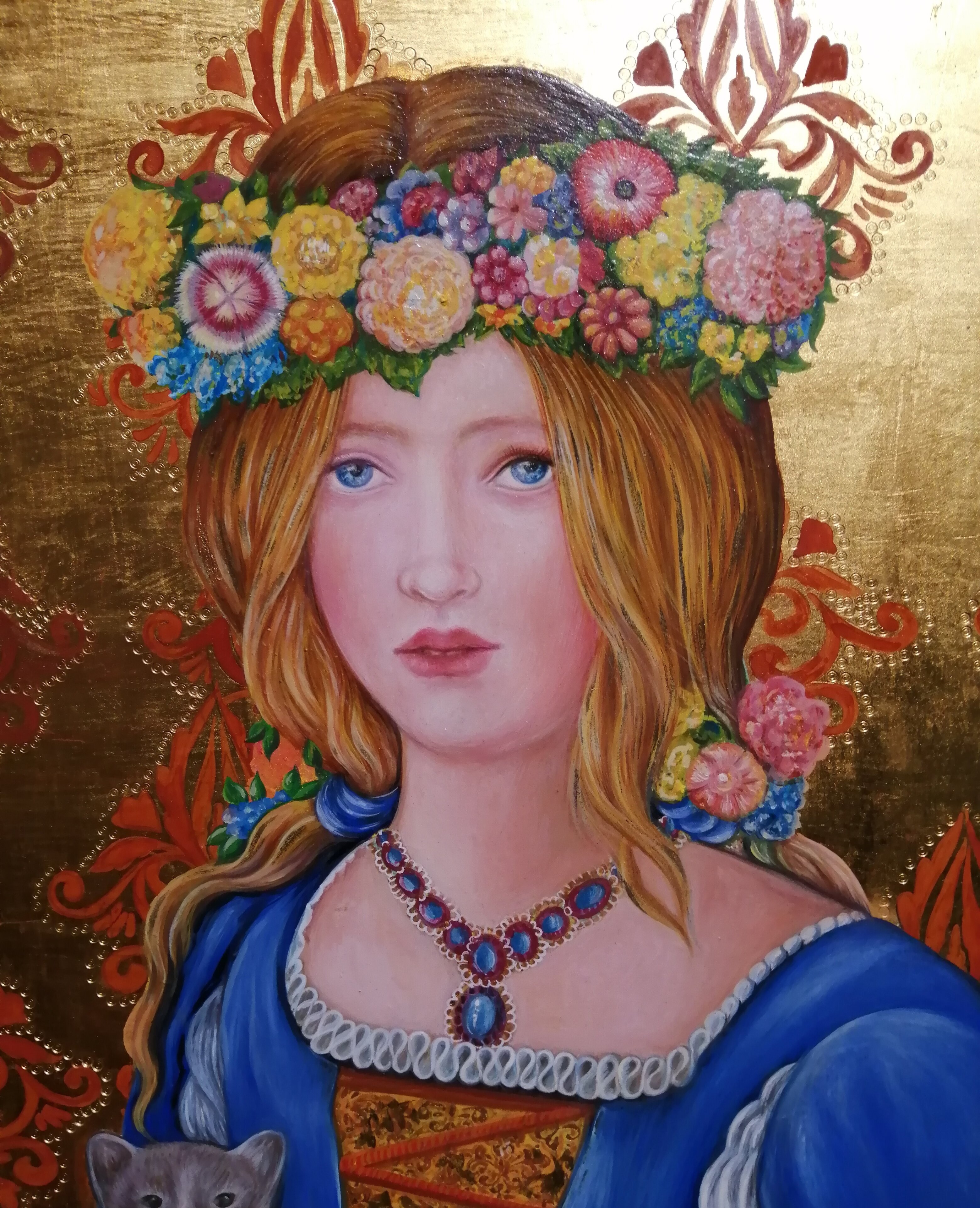
Lady with an Ermine in Renaissance Style
Silvia Salvadori - Copyright ®
Portrait of a little girl in Renaissance style executed with the techniques of the Tuscan school of the early Renaissance.
Ground in 23-carat pure gold.
Egg yolk tempera in the ancient Tuscan tradition. Renaissance painting.
Engravings on the brocades of the robes finely embroidered in pure gold.
Use of the original colours used by Cennino Cennino in The Book of Art.
Gold Painting by Silvia Salvadori . Copyright 2021
Tempera and pure gold on panel . Engravings executed with burin on gold.
Pigments taken from Cennino Cennini recipe book, 15th century.

 Silvia Salvadori
tempera and gold on wood
On
Portrait
Silvia Salvadori
tempera and gold on wood
On
Portrait
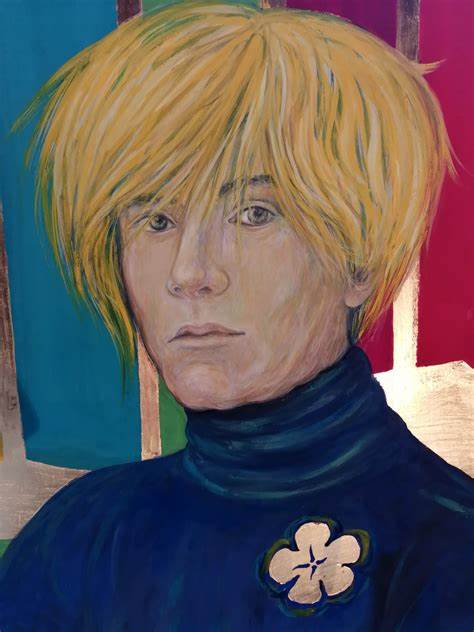
Andy Warhol. Self Portrait
Silvia Salvadori painted this beautiful portrait of Andy Warhol using Renaissance portrait techniques. In the portrait, Andy Warhol's Pop Art and colours are enhanced by the use of pure, bright pigments used in the palettes of the greatest Renaissance artists in Tuscany.
Silvia manages to create a perfect blend of Renaissance art and Andy Warhol's Pop Art.
Silvia Salvadori in her Bottega d'Arte Toscana paints portraits on commission in Renaissance and modern style using the original techniques of the early Renaissance Tuscan school. Even in this beautiful painted portrait of Andy Warhol, 23 carat pure gold was used.
Portrait on a gold background of Andy Warhol. Pop art in the Renaissance style.
Use of the same pictorial tecnique of the early Renaissance.
Pop art painting portrait.
Egg tempera painting.
Tempera and gold leaf on panel.
23 karat gold.
40 x 60 cm
 Self Portrait Andy Warhol
Egg tempera and gold leaf
Silvia Salvadori
Egg tempera and gold leaf
On
Portrait
Self Portrait Andy Warhol
Egg tempera and gold leaf
Silvia Salvadori
Egg tempera and gold leaf
On
Portrait
The work is a tribute to Arezzo and to the painting of Piero della Francesca. The element of the chessboard retains a great evocative and symbolic force. The chessboard in art represents the mathematics, philosophy, poetry and painting of the Renaissance where everything was constructed in a strictly geometric way. The lady painted in Renaissance clothes supports and embraces Arezzo immersed in a white space as if almost pushed by a massive explosion of pure energy. The Arezzo painted by Giotto appears to the viewers as a real heavenly Jerusalem "like a very precious gem, like a stone of crystalline jasper".
80 x 100 cm
The peculiarity of this painting by Silvia Salvadori lies in the use of precious gems (sapphire, emerald, amber, coral, lapis lazuli, rock crystal, ruby and pearls), the same ones described in John's Apocalypse and set directly on the golden surface. Remarkable is the rendering of the effects of light and shadow expertly recreated by Silvia in the drapery of the finely embroidered and engraved fabric on pure gold. Every detail of the painting is intended to be a tribute to medieval goldsmiths and the millenary goldsmith tradition of Arezzo. The figure is defined through a delicate linear outline. Rhythmic and flowing curves make the drapery light and elegant. Finally, the stylistic decorativism typical of medieval and early Renaissance painting is also found in the natural details such as the leaves and in the fruit of the pomegranate.
The Lady with the Chessboard was entirely made by carefully following each step described in Cennino Cennini's Book of Art. The gilding is also done with the gouache technique on gold, spread over an original Armenian bolus bed. The pigments used for the execution of the painting are all pure and original pigments. In particular, the same pigments of Piero della Francesca's palette were used for this painting. The azurite, for example, which was often used for the skies was used on the quadrants of the chessboard. The egg yolk tempera technique is distinguished from other painting techniques for the extraordinary brightness that it manages to emanate both on the complexions and on the plastic rendering of the drapery and it is for this particular aspect that it was used and handed down until the end of the 1500s.
Dipinto di Silvia Salvadori © 2021 tempera al tuorlo d’uovo su fondo oro zecchino. Pietre preziose e incisioni a bulino su oroThe painting was entirely done in egg yolk tempera on a 23 carat pure gold background. The pigments used are those of Cennino Cennini and described in the Book of Art of 1370. Egg yolk tempera is an ancient and very refined technique used in the Middle Ages and the Early Renaissance. Each table executed with this particular technique is first prepared following a stratigraphic scheme. The chosen support is often poplar or lime tree obtained by vertically gluing various boards together. The glue is the original described in Cennino Cennini's art book; the strong glue obtained with “mozzature di pecorine papers”, or parchment glue known as “rabbit”. On each board a whole or striped linen cloth is glued, impregnated with glue in order to block the movements of the wood. The penultimate phase involves the priming or the drafting of several layers (about eight) of thin chalk from Bologna or Volterra (Cennino Cennini, The Book of Art). The plaster is then shaved and burin or tablet decorations are then performed on top.
On Portrait

In this painting Silvia Salvadori lays the foundations for a new language that wants to be a poetic declaration at the same time: a temple for art, an initiatory place. The Minerva is for Silvia a tribute to Arezzo and its symbols.
Silvia's work is an opportunity for infinite poetic metaphors. Closed between its flowing golden lines, the dominant note of the painting is indigo blue and ultramarine blue green (pigments by Cennino Cennini) of the veil, which waving evokes the movement of water to symbolize the secret movements of nature.

The medieval and modern style are to be considered moments of a fundamental transition and a reached creative maturity.
In Minerva's painting, we find the abandonment of atmospheric pictorial values and the choice of a rigid and flattened spatiality, of interlocking compositions between naturalistic elements, ornamental motifs and precious materials, of a search for refinement and harmony that does not release tension but concentrates it, setting it like a jewel.
In Silvia Arezzo thus becomes a magical city immersed in a lunar landscape with a dreamlike charm, where its main monuments and places of worship become a demonstrative symbol of a city with a glorious and unforgettable past.
Minerva becomes a sovereign figure set in a precious surface like a jewel, an icon of a new cult. Gold is for Silvia the maximum representation of her "golden style" but also a timeless material of the continuous search for royal beauty. The peculiarity of the "Golden style" does not consist for Silvia only in the massive use of pure gold in leaf and powder, but above all in the structural role that this assumes in her painting. In fact, if, as in the Byzantine mosaic, gold in Silvia wants to transfigure reality, fix the image in an eternal sublime transcendence by freezing it in the perfection of metal as in the technique used by Simone Martini, Gentile da Fabriano and Gustav Klimt.
Painted by Silvia Salvadori © 2021 Tempera on a pure gold background 23 caratMinerva, Goddess symbol of freedom and the arts, in Silvia Salvadori's painting becomes a place of celebration of the woman as a powerful priestess of her Universe. The golden scaled cuirass completely engraved on the thin golden sheets enhance its strongly spiritual character, while the golden mirror-shield and the snake symbolize its Prudence.
In her we find the modern idea of the representation of a face combined with the representation of an ancient Tuscan landscape, a symbol of a distant past, where gold evokes the original depth of a land that preserves its light in the womb.
Minerva
Tempera on a pure gold background
On Portrait
In this work, the artist Silvia Salvadori wanted to represent the female archetype of the woman, mother and generator of the universe and of life.
Continues...
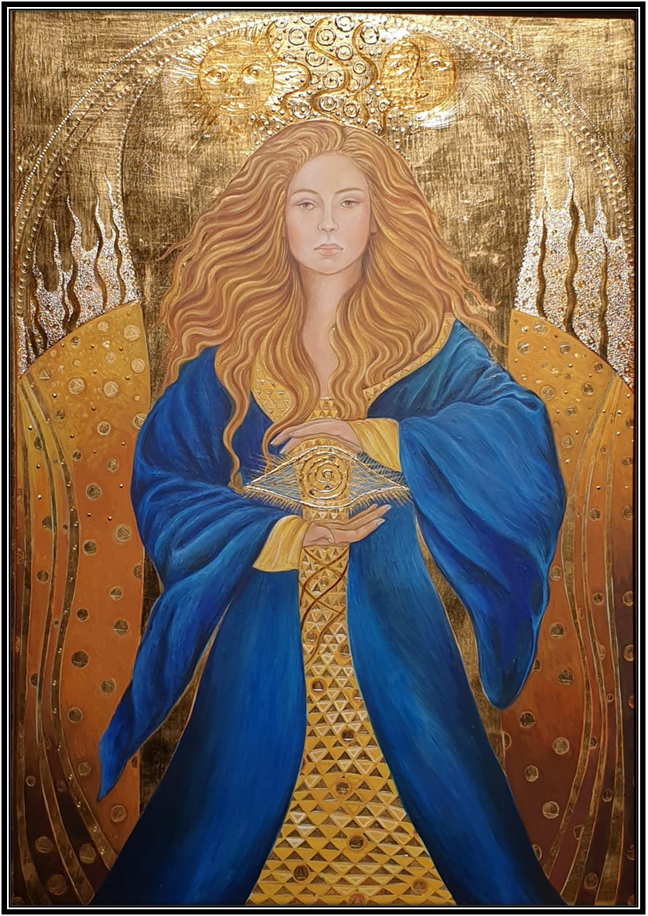
The woman, like a contemporary Mater Matuta, recalls Aurora, daughter of the titan Hyperion and of Teia, sister of the Sun and the Moon (which can be seen golden on the bottom).
It contains within itself the 4 elements, air, water, earth and fire: it is precisely in the latter in which it is immersed, but it does not torment it because it is part of it.
Aurora's mantle is blue, a blue that recalls the Sky that she radiates with Light with her Beauty. The gold present in the table and the triangles recall the fire, the golden engine, from which everything is born and regenerated.
Quoting Fulcanelli, an author of twentieth century alchemy books “Igne Natura Renovatur Integra” = fire renews nature.
Aurora, dressed in a blue mantle that recalls the Sky, is inserted in an energetic portal (the lines recall the art of the Viennese Gustav Klimt), and from her hands a Light radiates, the principle of Life (Fiat Lux) , meaning that all that is of the nature of light rises naturally towards It.
Painted by Silvia Salvadori © 2021
This work, therefore, is not only a tribute to Energy, but also to Life, and especially in a difficult moment like this, it reminds us that Life is Light, that light always wins over the darkness of death, disease and of calamities, and that the more we live in it, the more our life will radiate with the Colors of which the Light is composed.
On Portrait
Silvia Salvadori has chosen to depict a young woman dressed as Harlequin to represent Italy, home of the famous artist. Twilight symbolizes the past, while the dove symbolizes peace.
The presence of the Cypress on the right represents the Eternity of Art. The grape represent his Tuscany land and Cortona city recognizable in the Etruscan golden mask. The young woman dressed as a Harlequin in the painting represents Italy, the homeland of the famous artist. The twilight symbolizes the past, the dove for peace and the Cypress the Eternity of Art. Finally, the grape represents its land, Tuscany and its city Cortona, recognizable in the symbol of the Etruscan gold mask. In the painting we find typical elements of the Renaissance style and of Gino Severini's futurist painting harmoniously blended together. The pure gold leaf of the sky in the background and the angels evidence to Severini's past bond with the Byzantine pictorial tradition.
70 x 50 cm

 Painted by Silvia Salvadori © 2021
Tempera and gold on wood
On
Portrait
Painted by Silvia Salvadori © 2021
Tempera and gold on wood
On
Portrait
Painted by Silvia Salvadori © 2021
Tempera and gold on wood
On
Portrait
Japanese portrait.
In this portrait of a woman, Silvia Salvadori manages to bring Italy and Japan together, renewing their ancient friendship. In the painting we find the two great strands of oriental painting: Chinese “Kanga” and Japanese “Yamatoe”.
The Japanese imperial indigenous style was born around the year 1000 giving life to a thriving artistic season made up of bright colors, decorations in pure Gold and silver.
The young and proud woman in Renaissance clothes brings to mind all the splendor and pride of a people that has always been unique in the world.
40 x 60 cm 5000 €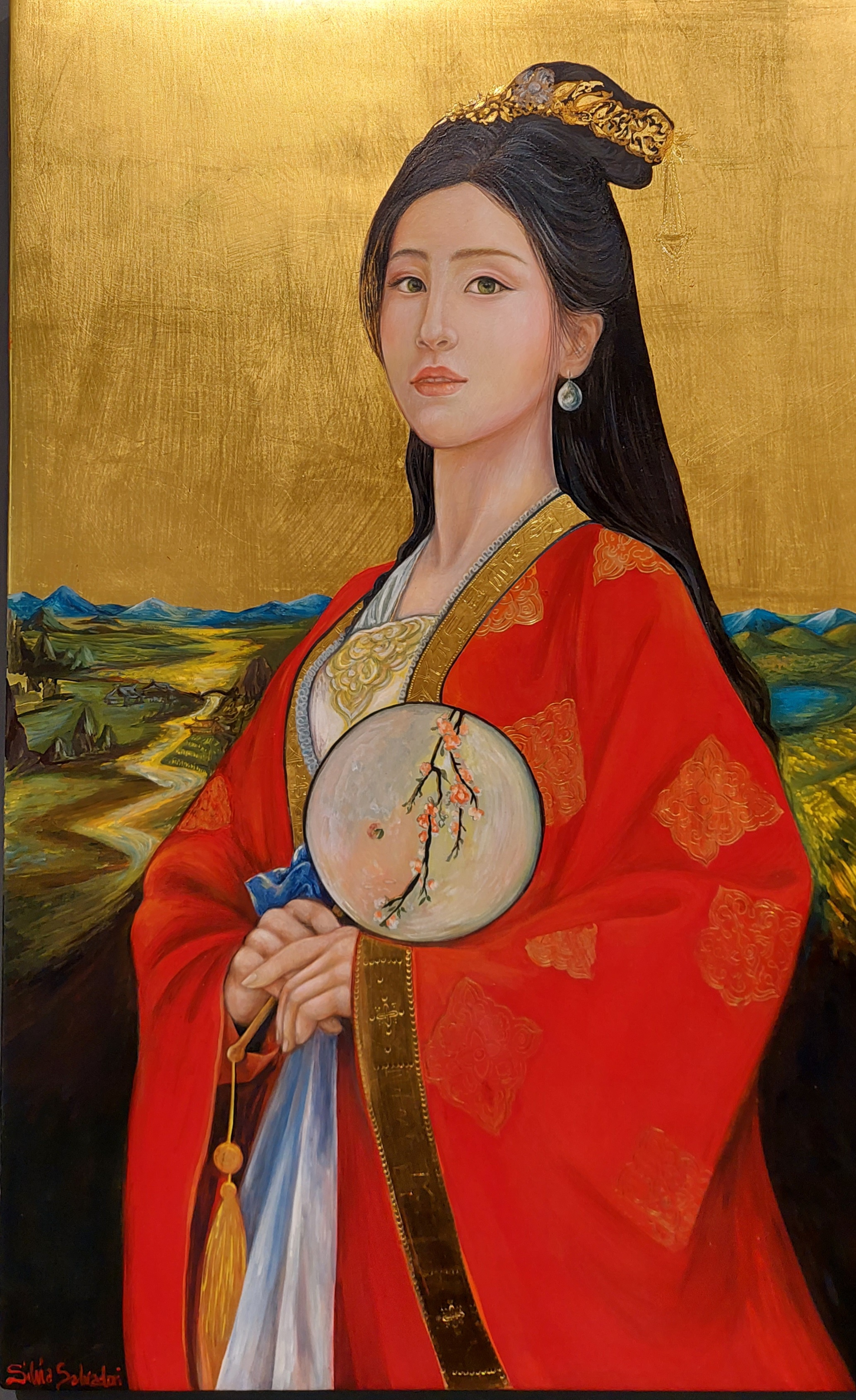
 The woman chosen is a young and proud lady in Renaissance clothes, a woman who brings to mind all the splendor and pride of a people, whose refinement and wisdom, made it and still makes it unique in the world.
The style chosen, in fact, refers to the ancient imperial splendor of the golden period of Japanese artistic production, corresponding to the Italian period of the early Renaissance. Also in this valuable work the artist applies the ancient pictorial techniques of the great Tuscan artists of the early Renaissance using the most precious pigments (carmine red from Monte Amiata, cochineal red, pure malachite green and the white of Meudon, or white of Spain, pigment inorganic mineral obtained from the grinding of oysters and used to make the face translucent. It is used in the classical age both in the west and in the east and then rediscovered in the fifteenth century).
It is a real attempt to unite the two worlds, heirs of ancient civilizations strong in ancient traditions. In this portrait of a woman, Silvia Salvadori manages to bring Italy and Japan together, renewing an ancient friendship.
Silvia takes as a reference the two great strands of oriental painting: Chinese “Kanga” and Japanese “Yamatoe”.
The painting was executed by the artist Silvia Salvadori on a 23-carat pure gold background and engraved with a burin according to the oldest gold working technique used in Tuscany since the late Middle Ages.
The pure gold background was gouache applied and the pure gold used is of the highest quality and thickness (Battiloro Giusto Manetti Battiloro, Florence). The decorations on the robe are all engraved on the gold background.
The young Japanese woman recalls the ancient splendour of the golden age of art in Japan. Silvia Salvadori wanted to decorate the robe with thin threads of pure gold following the Tuscan pictorial tradition of the early Renaissance.
Japanese Renaissance style art.
Painted by Silvia Salvadori.
Egg Tempera and gold 23 Karat on wood
The Japanese imperial autochthonous style was born around the year 1000 giving life to a flourishing artistic season made up of bright colors, decorations of pure gold, silver. The colors used in that period are very similar to the colors used by Cennino Cennini in Tuscany in the 1300s; malachite green, for example, is often used in the depiction of naturalistic elements and the various pigments of natural and mineral origin are finely ground and joined with metal plates to the pictorial support as described in the book of Cennino's Art.
On
Portrait
The woman chosen is a young and proud lady in Renaissance clothes, a woman who brings to mind all the splendor and pride of a people, whose refinement and wisdom, made it and still makes it unique in the world.
The style chosen, in fact, refers to the ancient imperial splendor of the golden period of Japanese artistic production, corresponding to the Italian period of the early Renaissance. Also in this valuable work the artist applies the ancient pictorial techniques of the great Tuscan artists of the early Renaissance using the most precious pigments (carmine red from Monte Amiata, cochineal red, pure malachite green and the white of Meudon, or white of Spain, pigment inorganic mineral obtained from the grinding of oysters and used to make the face translucent. It is used in the classical age both in the west and in the east and then rediscovered in the fifteenth century).
It is a real attempt to unite the two worlds, heirs of ancient civilizations strong in ancient traditions. In this portrait of a woman, Silvia Salvadori manages to bring Italy and Japan together, renewing an ancient friendship.
Silvia takes as a reference the two great strands of oriental painting: Chinese “Kanga” and Japanese “Yamatoe”.
The painting was executed by the artist Silvia Salvadori on a 23-carat pure gold background and engraved with a burin according to the oldest gold working technique used in Tuscany since the late Middle Ages.
The pure gold background was gouache applied and the pure gold used is of the highest quality and thickness (Battiloro Giusto Manetti Battiloro, Florence). The decorations on the robe are all engraved on the gold background.
The young Japanese woman recalls the ancient splendour of the golden age of art in Japan. Silvia Salvadori wanted to decorate the robe with thin threads of pure gold following the Tuscan pictorial tradition of the early Renaissance.
Japanese Renaissance style art.
Painted by Silvia Salvadori.
Egg Tempera and gold 23 Karat on wood
The Japanese imperial autochthonous style was born around the year 1000 giving life to a flourishing artistic season made up of bright colors, decorations of pure gold, silver. The colors used in that period are very similar to the colors used by Cennino Cennini in Tuscany in the 1300s; malachite green, for example, is often used in the depiction of naturalistic elements and the various pigments of natural and mineral origin are finely ground and joined with metal plates to the pictorial support as described in the book of Cennino's Art.
On
Portrait



