

Song of Songs by Silvia Salvadori
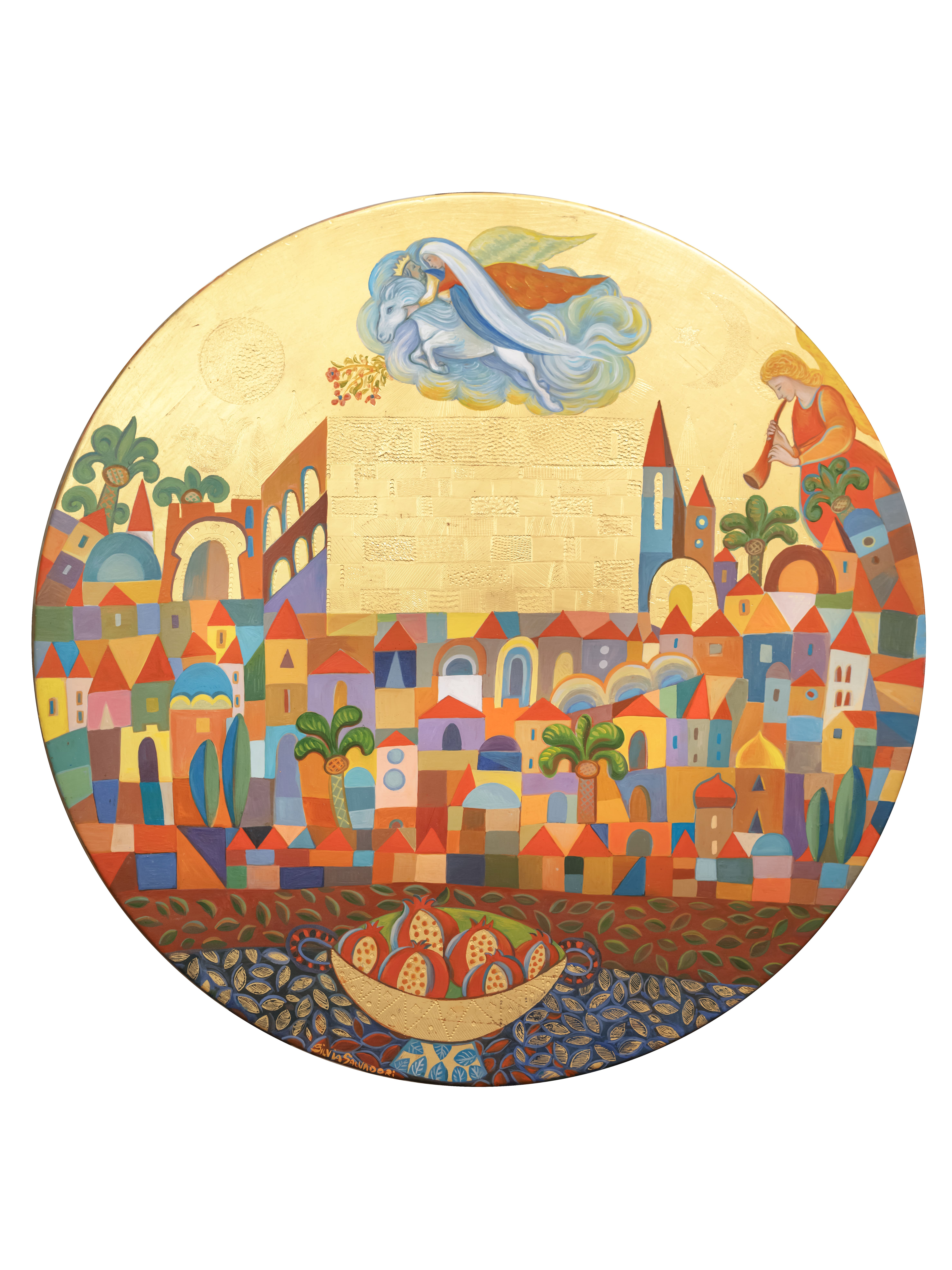
There are some painters who are accostumed to describe the world itself and some others that reveal its invisible aura. More specifically, Silvia Salvadori is an artist belonging to the second category. Her Jerusalem is not a simple view but more likely an inner memory that resurfaces in the light. Her tribute to Marc Chagall’s art is not something that comes from the pure imitation but rather from a spiritual connection.
While Chagall used to turn dreams into painting, Salvadori converts her painting into a meditation.
The use of colour itself loses every single narrative purpose becoming the language of soul. The tondo, the ancient symbol of perfection, defines a city floating between history and revelation. The circle doesn’t simply mark out the space but make it eternal. The viewer’s eye is drawn into the artwork by walking its silence like a pilgrimage. The fine pure gold leaf, gilded according to the 15th-century Sienese school tradition, gives back to the medium its holy dimension. The gold is used not only to cover the surface: it also works for getting much more light. Every reflection modifies the picture making the viewer feel part of the masterpiece.
The gold engraving shows a rare technical mastery. Every punching witnesses the relationship between craftsmanship and thought. The patience in the making of becomes an aesthetic value, an hand memory as well as a loyalty to a culture of doing. Jerusalem takes shape by a specific geometrical architecture where synagogues, churchs, mosques live together non-hierarchically. The composition goes beyond the news to establish a possible harmony among different cultures.
The Wailing Wall represents the emotional focus of the artwork. Its stones, meticulously crafted one by one, keep the importance of the memory and all together the strenght of hoping.
The story is not simply illustrated: it is transfigured.
The Musician Angel suggests a lyrical intensity by lightening the architectonical composition. Music itself becomes an invisible presence, a connection between earth an heaven, between the preciousness of the medium and the lightness of the spirit. Here the cubist influence is subtly integrated.
Geometries do not fragment reality but they put it back together in a close store where each volume communicates with the light. Silvia Salvadori underlines the importance of painting as mental discipline. In a world dominated by ephemeral things, she manages to get back the slowness of the making of, technical skills and the responsability of beauty.
By art critic: Paolo Levi



